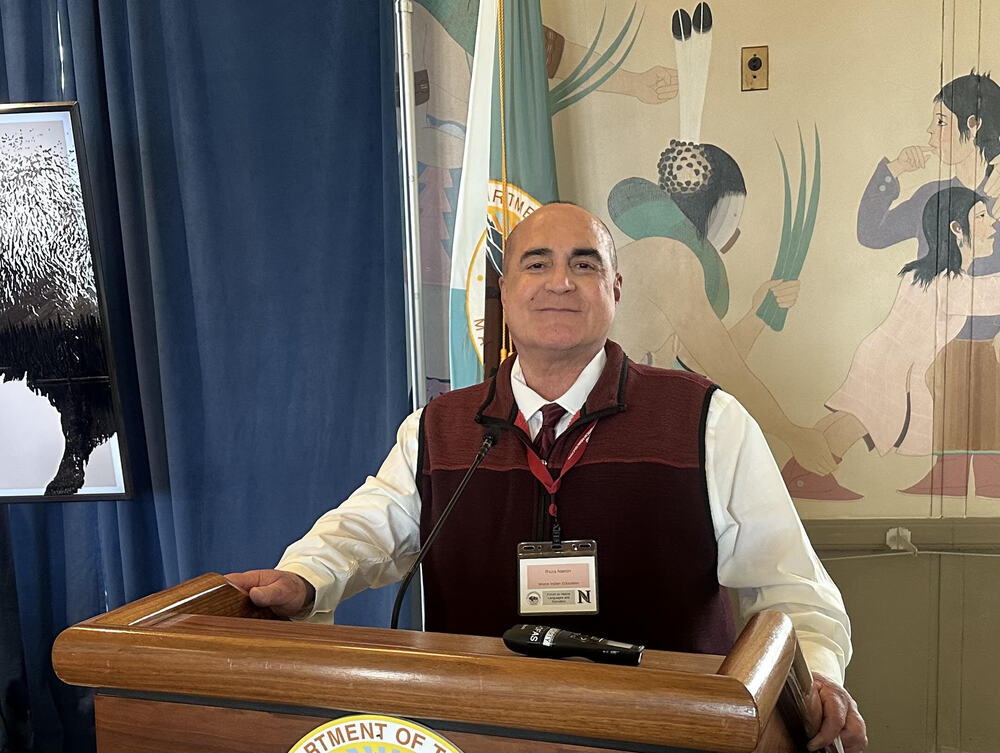
Maine Indian Education Superintendent Dr. Reza Namin Nominated for 2027 Maine Superintendent of the Year, Invited to Present at National Forum on Native Language and Education in Washington, D.C.
Dr. Reza Namin, Superintendent of Schools for Maine Indian Education (MIE), received two significant honors this month, reflecting his leadership in tribal education and commitment to advancing Wabanaki language and culture.
Nominated for 2027 Superintendent of the Year
Dr. Namin has been nominated as one of Maine's candidates for the 2027 Superintendent of the Year, an honor administered by the Maine School Superintendents Association (MSSA) in partnership with AASA, The School Superintendents Association. The nomination reflects the confidence and respect he has earned from MIE's School Committees and colleagues across the agency's three tribal community schools — Indian Island School, Indian Township School, and Sipayik Elementary School.
“This nomination is a reflection of the incredible work happening in our schools every day — from our educators and culture-bearers to our students and families,” said Dr. Namin. “Any recognition of my leadership belongs first to the communities of Indian Island, Indian Township, and Sipayik, who continue to show what is possible when education is rooted in identity, relationship, and rigor.”
Invited to Present at Assistant Secretary's Forum on Native Language and Education
Dr. Namin has also been invited to present at the Forum on Native Language and Education, hosted by Assistant Secretary of Indian Affairs Billy Kirkland, on September 10, 2026, in Washington, D.C. The forum will bring together tribal educators, language keepers, and youth from across the country for a day dedicated to advancing Native language revitalization and education.
A Record of Leadership and Innovation
Dr. Namin holds a Ph.D. in Mathematics and Science Education and completed postdoctoral study as a Harvard Fellow. He has been inducted into the National Superintendents Association Hall of Fame. He was also recently nominated for the National Association of School Superintendents (NASS) Excellence in Power Leadership award.
Under Dr. Namin's leadership, MIE's three schools have posted strong gains on the Maine Through-Year Assessment and earned statewide recognition, including a Maine Department of Education newsroom feature spotlighting Indian Township School's implementation of the BARR (Building Assets, Reducing Risks) model. He developed MIE's “Rigor, Relevancy, and Relationship” instructional framework and its MICI framework — Multiculturalism, Inclusion, Culture and Identity — grounding curriculum and school culture in Wabanaki identity and community values.
Maine Indian Education has produced one of the most significant multi-year reductions in chronic absenteeism documented among comparable tribal school systems nationally. Drawing on the Maine DOE Chronic Absenteeism Detail Extract (2024–25), the data tell a clear story:
School / System | 2021–22 (Est.) | 2023–24 (Est.) | 2024–25 | Trend |
MIE System-Wide | 52–60% | 33–38% | 19.6% | ↓ ~37 pts |
Indian Island School (Penobscot Nation) | 55–62% | 28–32% | 13.1% | ↓↓ Major |
Sipayik Elementary (Passamaquoddy, Pleasant Point) | 54–62% | 32–38% | 18.7% | ↓↓ Major |
Indian Township School (Passamaquoddy, Indian Township) | 58–68% | 38–44% | 27.0% | ↓ Strong |
Maine Statewide (All Students) | 31.0% | 24.0% | ~24% | benchmark |
National Am. Indian / AK Native | 42–48% | 38–43% | 36–42% | benchmark |
MIE system-wide chronic absenteeism: 19.6% — 80.4% of MIE students now meet the attendance goal, an improvement of roughly 37 percentage points from the 2021–22 estimated peak.
Indian Island School: 13.1% chronic absenteeism (only 11 of 84 students). This places the school below the Maine statewide average for all students and dramatically below the state’s American Indian student average of approximately 41.8%.
Sipayik Elementary School: 18.7% chronic absenteeism. Approaching parity with the Maine statewide average — a decline of roughly 35–43 percentage points from the post-pandemic peak.
Indian Township School: 27.0% chronic absenteeism, a substantial multi-year improvement from an estimated 58–68% in 2021–22, with continued targeted intervention underway.
These figures place MIE substantially below the current national American Indian / Alaska Native benchmark and competitive with — or stronger than — the Maine statewide average for all students. This is achieved against a national landscape in which American Indian students have consistently registered the highest chronic absenteeism rates of any subgroup, and in which BIE-funded and tribally controlled schools are not included in standard federal district-level analyses.